December 2009 Archives
Official, Legal gay marriage in Mexico City!!!By on December 22, 2009 2:37 PM | No Comments
The same-sex couples has won the right to get married next year in Mexico City, as the Federal District Legislative Assembly (ALDF) approved yesterday.
the amendments to the Civil and Civil Procedure allows "two persons" regardless of their sexual orientation, may marry. instead of "a man and a women" as it was before
this historical success wasn't easy, 39 votes for, 20 against and five abstentions, is not something that could happen ten or not even 5 years ago. with the support of more than 400 civil society organizations, the National Center for Prevention and Control of HIV / AIDS, the National Council to Prevent Discrimination and the Federal District Government.
There was also approved the right to adopt children and althought is well known catholic church is terrified and the conservative party wants to try everything to step back on this advance we all know children raised in homoparental famoiesare always wanted, and never cause of an accident. is something that you look for because you really want it.
This legal advance has given me the chance to decide if I want to spend my life with somebody and to share rights, privileges and responsibilities with the man I love.
I prefer people to say "I don't'want to get married " instead "I can't marry".
and as Irina Echeverria, a transexual activist, said. Right are not negotiable, or traded, there are not something ew have to beg for. Rights are something we have to exercise.
By the way... whoever who wants to come to my wedding day in 2010 is more than welcome!!!
By on December 16, 2009 11:59 AM | 3 Comments
It's not a newspaper note yet, but it's an initiative that is being discussed this week in the México City assembly, this is a PRD's proposition (Democratic revolution party) by ..... which pretends to change the definition of marriage from "the junction or arrangement between a man and woman" for "junction between two persons to share responsibilities, and civil rights" obviously this initiative is not being supported by the conservative political forces (Nacional Action Party) PAN)in the assembly are trying to make it impossible, I have to say this one is the religious party and where the mexican president came from.
"Our party may think about give some more rights to homosexual people and do things to benefit them, but there's no way this initiative get our approval since it wants to chance the definition of marriage, it may bring a lot of unexpected problems and legal unfilled spaces"
It's not that I believe in marriage , but I DO belive in rights and I think it's very important to get as many right as we can. I prefer to say "I don't want to" and not "I can't".
Definitively it's necessary to get acces to medical services thru your couple or partner if it's got this right, it's good to know that we can share a property, something of our own like buying a house together and it may belong to both of us and a lot of more stuff that heterosexual people has the righ to do.
Another discussion is about adoption. one thing is approving this law to marriage and another very different would be to adopt children, I`d prefer to get one step at a time and not nothing asking for both things at the same time.
There's a lot of possibilities this initiative gets approved, since PRD is mayority in the assembly and everyone has told they will give this vote, but everything can happen. So... let's wait for a while and if this proposition gets appoved I'll invite you everyone to my wedding day in Mexico!
Save the Date: 2010 Gay Men's Health Summit, August 25-30thBy on December 14, 2009 12:37 PM | No Comments
You can bet your buns I'll be hounding all you Trevorade drinkers to head out to Fort Lauderdale, Florida for the 2010 Gay Men's Health Summit! While technically the 11th anniversary of the first, we'll of course be celebrating the 10th anniversary (in gay years, as Lady Bartlett put it). Here's the as-official-as-GMH-gets release, written up by the lovely Michael Scarce:
SAVE THE DATE: National Gay Men's Health Summit, August 25-30, 2010, Fort Lauderdale, Florida.The mission of the Summit is to create a stronger, more diverse, and increasingly visible grassroots movement among gay, bi and trans men, focused on strengthening our communities and tackling a range of health concerns that include, but are not limited to, HIV and AIDS.
Next year's event marks the ten-year anniversary of the first National Summit, convened in Boulder, Colorado. Notably different from traditional health conferences, many have experienced our earlier summits as nurturing retreats, exciting think tanks, and moments of great enlightenment.
We hope to continue building on the success of previous summits as we mobilize to better our health and wellness, conduct strategic organizing, celebrate our past achievements, and create a renewed vision for the next decade of the Gay Men's Health Movement.
Be there! It's a lot of fun with a lot of wonderful, sexy men! And don't worry: It's not a conference. We strive for our gatherings to be more low-key, more personal, and less informal than professional associations. Hot tubs and hotel room parties are key to its success! If you are invested in Gay Men's Health at all - in any shape or form - and especially if you'd love to be surrounded by a group of guys who ARE similarly invested -- THIS is the place for you.
Chris Bartlettt Brings Social Marketing for the Dead to the NYTimes!By on December 14, 2009 12:22 PM | 1 Comment
Well color me proud! Our very own Chris Bartlett is featured today in a New York Times story on social marketing for the dead. Chris has jumpstarted the Gay History Wiki, which is a project that attempts to gather the bits and pieces of Philadelphia's gay history 1960-present on one little site. Archiving those who died of AIDS is a key part of that project. From the Times piece:

Beginning in 2005, Mr. Bartlett began assembling the names of every gay male Philadelphian who died after being diagnosed with H.I.V. or AIDS, searching obituaries and the Names Project registry of people commemorated by the AIDS quilt, combing through records of social clubs and the rosters at St. Luke and the Epiphany, the Philadelphia church that took on the task at the epidemic's height of "burying the people no one else would," Mr. Bartlett said.Inspired by Steven Spielberg's Shoah project, a Holocaust memorial, in 2007 Mr. Bartlett built a database on wikispaces.com, the free portal that invites editorial interventions, and by the end of last summer was ready to broadly promote his site. Unlike the AIDS quilt, an intensely elegiac but largely static artifact, the Gay History Wiki is a sprightly free space open to posts and tags, to biographical data added and amended by survivors for their vanished friends.
[snip]
Beyond the novelty of this approach is something equally important, Ms. Schulman of the Act Up Oral History Project suggested: the opportunity to fill in blanks in a haphazard narrative. "The AIDS story has been limited to depictions of doomed individuals," and not impassioned, ad hoc communities, she said.
A conviction that gay men and women and their friends came to one another's assistance during the crisis -- improvising buddy systems, treatment groups, food banks and other survival networks -- fueled Mr. Bartlett's pursuit, as he recreated a mesh of lives that unexpectedly turned out to have meaning for a cohort of young gay men.
"Everyone knows AIDS is a big issue, but for people 25 and under, it's not really a topic of discussion," said Evan Urbania, a 29-year-old marketer who regularly visits the Gay History Wiki. "I'm a social media guy, and the importance of involving the stories of people who have passed on, particularly as a gay man whose development was influenced by people who are 20 or 30 years older, is very powerful to me."
Oh, Chris! I'm tearing up a bit just reading this! Thanks for all you do, honey! xoxoxoxoxooxoxox
Federal Ban on Needle Exchange is DEAD!By on December 14, 2009 12:13 PM | No Comments

Hallelujah! Christmas has come a bit early for Prevention activists in the US. From Julie Childs over @ PreventionJustice.org:
This weekend, the Senate joined the House in approving the final 2010 appopriations bill that will lift the ban, without the deadly not-near-1000-feet-of-anything amendment that would have rendered it virtually meaningless.Long overdue, and now happening in the context of economic crisis where prevention efforts are being defunded on a daily basis due to state cuts. CDC must act on their pledge to do all they can to help syringe exchange now that the ban is lifted. It's not going to be easy.
But the best way to bring any possible justice to this long-standing affront is to immediately work with all due haste to remove any possible barriers - funding, local misinformation or bias, bureaucratic social service practices that would alientate users, etc - and get the needles out where they are needed. As has been said so many times before, the point is the point.
Needle exchange is one of those tried and true tools in our prevention toolkit. We know it works, but dag nabbit if the government hasn't stymied efforts to put it into practice by criminalizing its practice. This is one important step forward, but as Julie notes there are more barriers in place at the level of bureaucratic policy, funding guidelines, and state and local legislation regarding the practice.
Incommensurable Outcomes: How Much is Life Worth?By on December 7, 2009 12:37 PM | 4 Comments
If you've ever gotten into a debate over healthcare with conservatives, you're very likely to butt heads over a key central issue: Who's going to pay for all this care? I wanted to take a moment to reflect on this question, and in particular consider the idea that these outcomes -- health, life, or death -- are incommensurable. That is, you cannot simply translate these outcomes into a monetary metric. In short, 100 lives does not equal $100.
I was recently trying to explain this concept as it relates to healthcare to my students, and I used the following example: "So if I said to each of you, I'm going to die unless you all give me ten dollars, most of you would probably say that this is reasonable and you'd be willing to shell out the dough. But what if that cost goes up to $100? $1000? At some point, you're probably going to say, 'Trevor, I like you very much, but I just can't afford that. Very sorry. Best of luck!'" They all got a laugh out of that, but I think it illustrates the idea that you simply cannot translate one life into some sort of monetary value. This is most strangely illustrated when driving across the country and notice that killing a road worker is valued differently in different states. Here in Michigan, for instance:
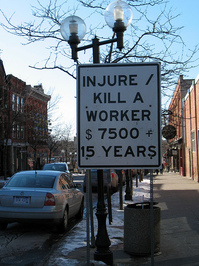
Other states have laws that value road workers' lives differently. To say that this is perplexing is a bit of an understatement. Why $7500 and not $10000? When it comes to healthcare, this has been most explicitly debated in regards to things like preventative care. Take for instance the recent debate over mammograms. The U.S. Preventive Services Task Force updated its guidelines to suggest that women in their 40s should not have mammograms, because of the risk for false positives: "While roughly 15 percent of women in their 40s detect breast cancer through mammography, many other women experience false positives, anxiety, and unnecessary biopsies as a result of the test, according to data."
Here what we have is a kind of valuation of two outcomes: 15% of women detecting cancer, and a less specific group of "many women" who experience "false positives, anxiety, and unnecessary biopsies" because of the test. This Task Force has made a decision that the latter outcome is too costly to merit the former. Put plainly by the chief medical officer for the American Cancer Society quoted in the article: "With its new recommendations, the [task force] is essentially telling women that mammography at age 40 to 49 saves lives; just not enough of them."
How do you decide what is right and wrong in this scenario? Should all women over 40 get mammograms? Notably, these are just recommendations for care -- there is no mandate behind this guideline that would necessarily prevent a 42 year old woman from receiving a mammogram should she ask. But her doctor may reasonably say that the test is costly (not just financially, but also in terms of medical risks) and statistically her risk of detection is low, and therefore strongly suggest she not get the test. Some doctors may even outright refuse her the test based on the guidelines.
Here we creep up on an even more controversial debate within healthcare: Who controls healthcare decisions -- patients or doctors? With the recent growth of advertising for pharmaceuticals, it's clear that we are moving to a patient-centered approach to healthcare. You diagnose yourself before going to the doctor, and then show up demanding a prescription for Zoloft because you saw a television ad describing symptoms that you then relay to the doctor. We expect doctors to make informed decisions about the various treatments they prescribe, but when faced with a very demanding patient may err on the side of caution.
At the same time, patients with greater access to medical knowledge and resources are much better able to demand the care they think they need -- while patients with lesser degrees of access are unable to do so. Somewhere down the line, you and I are paying for that patient's Zoloft prescription -- whether we like it or not. We're also not paying for countless medications and treatments for patients who either have no access to care or are not as able to demand that care. Thus, there is a socially stratified (by race, class, geography, education, etc) access to treatment based on different levels of access to both services and to knowledge.
I am not enviable with those tasked with legislating these kinds of irrational rationalities (irrational in their incommensurability, rational in their formalized, calculated nature). We not only need to take care to carefully think through how we attach value to health outcomes that are invaluable, but also to consider how these valuations are likely to be socially stratified in their outcomes. Women over 40 might well be good candidates for mammograms, but how many women in the 40s will actually wind up getting that care? And how much are people collectively willing to pay for those mammograms? How much more are we all willing to pay to ensure that any woman who wants that mammogram can get it? $100 a year? $1000? At the end of the day, these are the questions that make healthcare reform downright maddening. There is no right answer. Precisely because there cannot be.
You'd better kiss my [fat] ass: Brüno, Precious, and the Quest for StardomBy on December 4, 2009 11:00 AM | No Comments
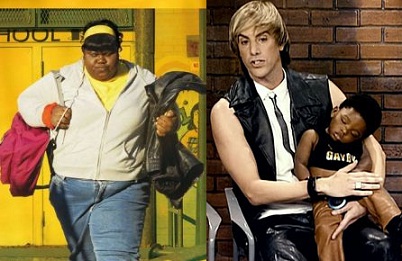
Some things may happen when you watch two different movies in the same week: having nothing in common, you can't help suspecting that somewhere, somehow, they have a connection - a relevant one. So I was trying to figure out what could be the link between Brüno and Precious: I had watched the first one because it just had been released in DVD in the States and the second one because Oprah Winfrey had decided - and I agree with her - that America had found the equivalent of a new Color Purple. Alas, all I could find at first was that both movies are eponymous, provocative and successful, but this was not meaningful enough. Thinking more about them, or letting them haunt me for a while (I love to do that!), I sensed that both Brüno and Precious were cast as anti heroes more than heroes, and that they were looking for fame in a strong, obsessive way. The content of the fame they were looking for did not matter, by which I mean the reason why they would become famous, or the talent that would explain why they deserved celebrity. Fame mattered above all as a goal, regardless of its means, as the reward changing one's life in a magic, arbitrary way.
Brüno thinks he's already a star, he just needs people to realize it and worship him as the idol he's always been. As people are ungrateful, or blind enough not to recognize him as an innate star, Brüno flies from Austria to Los Angeles in order to help the whole world understand he's simply fabulous and incredible. His obsession with stardom requires all his time and energy and does not leave space for anything else: Brüno doesn't have any sense of ethics or spirituality; he has no time and no will to deal with existential issues about his or other people's lives. Brüno embodies what happens in a society based on consumption, individualism and political correctness: the advent of an empty, cynical consumer enjoying life as an endless TV show and requesting his slice of fame - but much more than the 15 minutes of fame Andy Warhol thought everyone could claim. The inhumanity of Brüno comes from the fact that he stands for the unbearable, yet comic paragon of a narcissistic subject ready to destroy people and insult their values if it helps get the attention of the paparazzi. Brüno is not just a caricature of a shameless, unscrupulous dandy desperately trying to make it in LA, he is more the vision of horror we can sometimes see in the mirror because we live in this society in which entertainment and the privatization of morals culminate in the quest for stardom as the ultimate, superficial and only thing worth wishing for.
Another interesting question raised by Brüno is "How can you become a star when you're openly gay?" The movie articulates the double bind analyzed by Eve Kosofsky Sedgwick in Epistemology of The Closet in a brilliant way. This double bind is still functioning today. I like to interpret one of the scenes of the movies, when Brüno is getting anal bleaching, as a metaphor describing how society is processing our subjectivities through the lens of marketing and idolatry. Far from being eccentric and crazy, Brüno is like us and shares the same cultural determinations: he's just one step further, showing us the way. At this point, the comedy is a tour de force; it becomes political satire and leaves us with a sense of emergency.
Precious is definitely further away from Brüno's selfishness and self confidence. It's euphemistic to say that life has been tough with her since she's always been beaten by her parents, raped by her father who ended up giving her two kids and one virus (HIV), and not to mention exploited physically and psychologically by a resentful, cruel mother in a poor, dangerous neighbourhood in Harlem in the 1980s. Her mother keeps telling her that she's stupid and useless, that she should have aborted instead of raising such an ugly animal. For the spectator it's a miracle that Precious (what an ironic name) manages to grow up in this constant hell. When she's being raped by her father, or whenever she's trembling on the verge of despair, Precious runs away from reality and finds herself sexy and glamorous on the stage of her dreams, surrounded by smiling, beautiful boys watching her with admiration and tenderness on the beat of nice music. Then Precious wakes up, back to the abuse and humiliation.
Her quest for fame should not be understood as capricious, it's rather a survival technique, a line of flight to distract her from the unsustainable rumination of pain, lack of love and loss of luck. Thanks to an alternative educational program ("Each one teach one") and the chemistry with her lesbian teacher (Miss Rain), Precious discovers a sense of dignity and the expressions of care and trust in the gaze of compassionate new people in her life (Mariah Carey as a social worker - actually very convincing -, and Lenny Kravitz as a nurse to die for). Step by step, she builds her own self, enjoys some privacy away from her mother and, above all, gains the power and the will to speak for herself, to write in her name - hence her memoirs, on which the movie is based, and by now its international fame.
Thus, stardom means a lot for both Brüno and Precious, and in the end they both achieve it, but here trajectories are just opposite: Brüno proved how inhumane he is willing to become in order to be a star - just any kind of star -, whereas Precious was reached by fame as the indirect consequence of a long, hard, emotional initiation to integrity, courage and self esteem. Eventually, what Precious and Brüno have in common, in spite of their striking contrast as cinematographic genres and psychological characters, is that they both point the crucial impact of the quest for stardom from a sociological perspective, and the space for political agency attached to it.
Southpark on The Cure for AIDSBy on December 1, 2009 10:45 PM | No Comments
On this World AIDS Day, I think this still remains one of the most hilarious and yet deeply insightful commentaries on the virus. Thanks, Southpark!
If you haven't seen this episode, watch it ASAP. You'll thank me later.