June 2010 Archives
Frameline 34: "The Adults in the Room"By on June 25, 2010 3:19 PM | No Comments
"THE ADULTS IN THE ROOM"
Director: Andy Blubaugh
Trevor's Rating: 5 / 5 Stars
*** EDITOR'S PICK: TREVOR'S 2010 FRAMELINE FAVORITE ***

My luck at Frameline just never seems to end this year. I've laughed. I've cried. And now with the addition of The Adults in the Room, I've had to think. Hard. This is hands down the most creative, challenging, and fascinating film I've seen this year at Frameline -- and perhaps ever. I know, I know -- that's a bit of a strong statement, but it reflects my love for this film. It is nothing short of incredible.
To say that this film deals with controversial subject matter is an understatement. Sex between people classified as minors and those classified as adults is perhaps one of the most heavily policed sexual boundaries. Maybe only incest is regarded with more disdain. Young people are not supposed to be sexual, and when they are with their peers it causes anxiety. When they have sex with people older than them, it causes outright panic.
This film cannot be easily classified. It is part documentary, part feature. Part fiction, part true story. It takes everything you expect about a film and throws it out the window. As such, telling you about it here is something of a challenge. But here goes.
When director Andy Blubaugh was 15, he had an intimate relationship with the father of his classmate. In The Adults in the Room, we get to see Andy grappling with the memory of this relationship. We see him meeting with friends to discuss making the film, his conflicted emotions about the relationship, and his angst over how to represent his lover without painting him as either totally innocent or guilty, so to speak. We see him auditioning actors to play both his younger self and his older lover, and the real discomfort that these actors experience when they realize they're expected to make out on screen. We see him discussing the "character" Andy's motivations with friends and teachers. We even get to see Andy in the classroom, teaching students about film-making (which reads as documentary, but is actually reenacted for the film by volunteers).
Alongside these self-reflexive and incredibly insightful vignettes into the filmmaking process and into Andy's brain, we get pieces of the finished narrative product. The actor cast as the younger Andy was in fact 16, and does in fact make out with his costar. He's pretty incredible and does a great job of conveying conflicted youth on screen. As the director noted during the Q&A, there is a difference between a 20 year-old playing a teenager and an actual 16 year-old on screen. Teenage angst is just about impossible to recreate without seeming farcical or overplayed.
What I especially love about these feature segments is that, because of the inclusion of the documentary-esque portions, the reconstructed artificiality of this story becomes apparent. Often times we take more seriously stories that are based on true stories, but of course what we remember is not actually what happened. It is our reconstructed, reformulated memory of those events. Because we get to see real-life Andy typing and editing the script for the scenes in the feature segments, it becomes impossible for the viewer to consume the story as if it were actually "reality." This of course should not be a way of discrediting the representation of that reality. Indeed, reconstructed memories are how we make sense of our lives and create our identities. They form the foundation of the decisions we make today -- of who we are as people.
I can't also applaud more loudly Andy's carefulness in dealing with this subject matter. He never claims to have the answer, to exculpate his lover or intergenerational relationships generally. He has his experience, and he sticks to it. This is a difficult decision when dealing with an experience that is caught up in such a web of sticky political issues. Representing that experience without making dramatic claims about its political rights and wrongs is no easy task. Put another way, he sticks to what he knows best. What that allows as a viewer is to leave the film asking the political questions, which is exactly what I did. Because he did not give us easy answers, my friends and I were still talking about that film two hours later.
I could keep writing about all the things I loved about the film, but I'd wind up taking away the pleasure that you will undoubtedly have in watching it yourself. I desperately hope this film gets distributed. You need to see it. And I can't wait to see it again! You can follow the film's progress on their website.
Here's a trailer:
Frameline 34: "Undertow"By on June 25, 2010 2:43 PM | No Comments
"UNDERTOW"
Director: Javier Fuentes-León
Trevor's Rating: 4.5 / 5 Stars
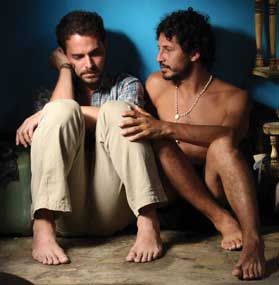
Shot on the stunningly beautiful Cabo Blanco coast of Peru, Contracorriente ("Undertow") is a quirky and tumultuous love story between a stranger and a small town local who struggle to keep their relationship a secret. You think you've heard it all before, but there's a bit of a twist: The stranger dies while swimming along the coast and his ghost is now haunting his lover. The acting is solid, with wonderful performances by both male leads. But it is the steady direction by Fuentes-León that truly shines here, made all the more impressive by the fact that this is his feature directorial debut. We were lucky enough to have him at this screening, and he is incredibly charming
I really wanted to love this film, and I think it is pretty incredible. But it just never really hit me in the gut, where you would expect such an intense and dramatic love story to hit. I guess I should have identified with the stranger in town, who wants his married-with-child lover to run away with him. He is certainly the more readily identifiable as gay of the two. But I felt little interest in him nor his closeted lover. Perhaps it is the two men's masculinity that makes me feel distant. Their's is the kind of even-keeled, easy-going masculine way of being that has always intimidated me.
Nevertheless, I can certainly recognize the beauty of this film. It's definitely worth checking out.
Frameline 34: "Sex in an Epidemic"By on June 25, 2010 2:21 PM | 2 Comments
"SEX IN AN EPIDEMIC"
Director: Jean Carlomusto
Trevor's Rating: 2.5 / 5 Stars

This documentary is a strange mix of things -- an attempt to throw everything about AIDS from the start to the present into one confused film. Archival footage is rarely identified, creating confusion over whether the interview you're watching was conducted by the filmmaker or was just rescued from the annals of history.
Indeed, this is one of those films that is well intentioned but poorly executed. There is plenty of interested archival footage, but it is stitched together weakly without a strong narrative structure. Unlike We Were Here, this film lacks the kind of clear focus and narrow scope that made that film so powerful. It pretends to be telling a national HIV story, but it's really about New York City. What happened there did not happen in San Francisco, and those differences go unspoken in the film but were clear. ACT UP happened in New York for a reason, but we don't hear about that because the film has no concept of its geographic specificity.
This film will be a resource for those looking for archival footage, and a random array of interesting but vaguely related facts. Here's a trailer:
Frameline 34: "Off World"By on June 23, 2010 1:42 PM | No Comments
"OFF WORLD"
Director: Mateo Guez
Trevor's Rating: 4 / 5 Stars
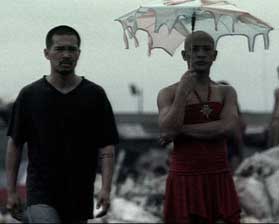
I'm left with more questions than answers after seeing Guez's stunning Off World, which is probably the director's goal. Lucky (played by the intense Marc Abaya) returns to the Philippines after being raised for the bulk of his life by a Canadian family. His mother gave him up for adoption when he was a toddler. He returns to Smokey Mountain, a slum outside of Manila that is depicted in all its horrifying decay. It is something of an enormous landfill, except that thousands of people happen to live there. The smoke in the air that gives it its name is the product of the decaying trash releasing methane gas and other toxic chemicals.
Lucky is of course trying to find himself, his identity, and he is aided in this quest by an NGO employee, Julia. She facilitates a reunion with his brother, who he initially rejects because of his genderqueer presentation. What follows is a strange and disturbing journey through life in the slum and the emotional confusion that comes with meeting a family you never knew. It is a story that is familiar, in a setting that is grotesquely strange.
What is unclear is the relation between director Mateo Guez and the main character. There is a strange moment at the end where the narrator (the main character) points out a child riding on the back of a garbage truck. He says that he paid for him to go to school next year, and he'll be coming back to make sure he went. This is a strange moment. Is this the director speaking? The actor? The character? It's unclear. It seems to be saying: "Don't worry. I didn't go here, make a film, and abandon it." But without a better understanding of who is speaking, it's impossible to interpret this sequence.
Adding confusion is that the film is not subtitled. Most of the dialogue is English, but there are extended sequences in Tagalog. We can generally intuit what people are saying, but nevertheless are made to feel as outsiders -- which is certainly the point. It is Lucky's perspective, who also does not speak the language. This is a very useful device in the film, and a decision worth applauding.
But this decision may have had too much of the effect it intended -- despite its stunning beauty and horror, I never really connected with the film. The poverty on display is indeed horrific and terrible depressing. But while the story is interesting and compelling at times -- notably in a drug-induced binge that takes Lucky through the slums -- it just seemed to fall flat. Perhaps it was never developed. Perhaps the acting wasn't compelling. Perhaps its because the primary love story is heterosexual. Or perhaps as a viewer the material is so unfamiliar that it cannot feel anything but alien. It's a beautiful film -- I cannot deny that. I just felt like there was something missing.
Here's a trailer:
Frameline 34: "Brotherhood"By on June 23, 2010 1:08 PM | No Comments
"BROTHERHOOD"
Director: Nicolo Donato
Trevor's Rating: 4.5 / 5 Stars
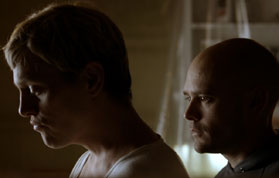
I've had extremely good luck with movies this year. Donato's Brotherhood was no exception. Rare is the film that takes on the subjectivity of the hated so intently, exploring what is taboo and almost entirely unspeakable without apology. More specifically, this is a love story between two neo-Nazi radicals.
If you had to flinch a bit when reading that, you're not out of the norm. Characters such as these -- along with racists, homophobes, etc -- rarely are allowed sympathetic airtime on film. We prefer to see them get their due or repent and become rehabilitated. And in some ways, this film does wind up rehabilitating its characters, but not in the typical sense.
The story is quite wonderfully set-up and executed. Lars (exquisitely played by Thure Lindhardt who you may remember as the self-flagellating cult member in Angels & Demons) is forced out of the Danish army because his subordinates suspect he is gay. He is angry, dejected, and desperately seeking some kind of sociality. He unexpectedly finds himself at a recruitment meeting for a local neo-Nazi group held informally at a friend's apartment. Their issue of the day is of course immigration, and in particular those from the Middle East. A local refugee center is their target.
Lars doesn't sign up enthusiastically, but is rather courted by the group's local leader who sees in him a bright young spirit who could bring a discipline and intelligence to the group. A violent initiation leads him ever more into the hands of his comrades as he runs away from home and moves in with a prominent member, Jimmy, who is suspicious of the new recruit and the attention the leader gives him.
What follows is something in a study of deeply repressed homosexual desire and the violence of masculinity. It is quite wonderfully depicted here. It is indeed the love that dare not speak its name. Many times in the movie, I would find audience members laughing at parts that I found utterly sad. Like the moment Lars wakes up to find himself in bed with Jimmy. There is a terror in his eyes -- and panic. The audience laughs, but this is not a funny moment. He is of course scared of himself and what he has done, but also of what Jimmy might do to him if he wakes up.
I would also applaud the way in which the idiosyncrasies of neo-Nazi culture are explored here. Jimmy drinks organic beer because we have to be good to the environment -- protecting that which is natural is one the their central tenets. Set alongside the group's binge drinking and destructive practices, the irony is indeed exposed. Violence against gays is important, but terrorizing immigrants is the top priority. All of these ways expose their worldview and its contradictions.
Some of my friends felt like the film was bordering on "Nazi porn." I disagree. I think that's the easy and obvious way to write this film off. But if we want to work to dismantle hate ideologies, we desperately need to understand that its practitioners are actually human and find the humanity in them. That is in many circumstances an absolutely terrifying project -- but I think it's critical.
Here's the trailer:
Frameline 34: "The Last Summer of La Boyita"By on June 23, 2010 3:29 AM | No Comments
"THE LAST SUMMER OF LA BOYITA"
Director: Julia Solomonoff
Trevor's Rating: 4 / 5 Stars

Something incredible is happening in Argentina. At the 2008 Frameline Festival, I saw for the first time what has become one my favorite movies of all time -- XXY -- which deals beautifully with the issue of intersexuality and the medicalization of sex and genitals. Now we have another incredible entry treading similar territory, The Last Summer of La Boyita. While there are some important differences, it's quite incredible that one country has made what are perhaps the two most compelling feature films on this topic.
The story is a classic summer tale: a doctor takes his daughter Jorgelina to the countryside where she forms a flirtatious friendship with a boy named Mario. They ride horses together. She swims in the pool while he whittles wood into rough sculptures. She protects him from the aggressive older boys who make fun of him. Mario is gearing up to race so that he "can prove he is a man," as Jorgelina's father says. Adolescence awkwardness and anxiety are wonderfully captured here.
Jorgelina becomes increasingly curious as to why Mario refuses to come swimming with her. She's pretty savvy, and after noticing blood on his pants she searches for answers about boys' menstruation. When she finds no answers, she turns to her father.
Unfortunately because of its subject matter and setting, the automatic comparison is XXY, which is a masterpiece of a film. The Last Summer doesn't quite measure up: The acting and casting isn't as incredible, the story is slightly less exciting, the presentation less provocative. But it is a wonderful film, despite its occasional shortcomings. The breathtaking country setting make for stunning cinematography. And there are some very funny and incredibly endearing moments. It's a real gem of a film.
Check out the trailer -- and keep an eye out for it!
Frameline 34: "Dzi Croquettes"By on June 22, 2010 2:07 PM | No Comments
"DZI CROQUETTES"
Director: Raphael Alvarez and Tatiana Issa
Trevor's Rating: 4.5 / 5 Stars
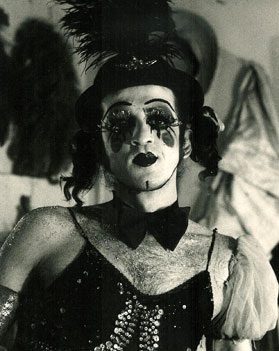
What a charming film! Many of you will be familiar with The Cockettes, San Francisco's infamous drag troupe that ruled in the 1960s and 70s. Less of you will be familiar with Brazil's amazing counterpart, "Dzi Croquettes" (a title they came up with while eating the French fried food). The director Tatiana Issa's father worked as part of the group's technical staff, and she grew up with the troupe around them. There is clearly a lot of love packed into this gem of a movie, with each of the 13 cast members getting due attention and care.
This is both a feature and a flaw of the film, and it's inherent in documentary making. So many stories to tell. So little time to tell it in. But I cannot fault the film for it, for the stories are so incredible that I cannot imagine having to cut any of them. The troupe had a long and fiery road to fame, with plenty of fights and trists and romances along the way. Their performance style is simply uncanny -- a kind of pastiche of numerous genres that come together to create something fabulously unfamiliar, exciting, and totally queer. It's not like the drag you see on Ru Paul's LOGO show. It's performance art.
What is particularly incredible is that they came into fruition at a tumultuous time for Brazil: an oppressive dictatorship whose grip on the nation was ever-tightening. The film specifically sites the impact of AI-5 (Ato Institucional Número Cinco), which shut down Congress and suspended many civil rights. The government had no way of understanding the Croquettes -- their performances were not explicitly against the regime, and thus they managed to slip under the radar and convince the government that they were harmless. Given the censorship that was going on at the time in Brazil, this is truly amazing.
Liza Minelli -- of all people! -- was instrumental in bring the group international acclaim. She helped them secure precious media coverage after she had seen them in Brazil. She's always a wonder to watch on screen, and it was really very generous of her to make time to be interviewed for this piece. Even Josephine Baker herself had a hand in bringing the Croquettes fame: Before she died, she told the theatre owner that they should take over her spot at the show. Just a few days later, she died on stage. The theatre owner kept her wish, and their run at Paris was hugely successful.
I'm dying to get my hands on a video of once of their performances. They're truly incredible. In this trailer below for the film, you'll get a taste. Get your hands on this wonderful film if you can! Enjoy!
SF: Do You Want MORE For Pride Sunday?By on June 22, 2010 2:01 PM | No Comments
If you haven't heard me blog about Juanita More's Pride Party, you clearly must be new to this blog. It's the best party in the world. And if you're in SF and looking for a good time, you gotta be there! See my coverage from 2008's party for a taste. Go to Juanita's website for more info.
Frameline 34: "We Were Here: Voices from the AIDS Years in San Francisco"By on June 22, 2010 3:44 AM | 2 Comments
"WE WERE HERE: VOICES FROM THE AIDS YEARS IN SAN FRANCSICO"
Director: David Weissman and Bill Weber
Trevor's Rating: 5 / 5 Stars
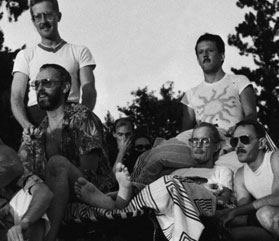
I can recall sobbing uncontrollably exactly three times in my adult life. Last night was one of those times. I ventured out to the Castro theatre for the "sneak peek" screening of "We Were Here: Voices from the AIDS Years in San Francisco." I knew I was in for a tear-fest, but I had no idea just how incredibly moving and utterly devastating the film would be. Before the screening, both the filmmakers admitted not wanting to make this film -- how can you possible represent the horror of those years without doing some injustice, without leaving some story untold? The idea is daunting.
No documentary to my knowledge exists that chronicles these years so intently, most likely because these stories are so incredible painful to tell -- and just as painful to listen to and absorb. I can only imagine that this film's road to the screen is paved in rivers of tears. As someone who did not experience those years, these representations are my only access to the memory of an era that shaped my gay world. It's why I have the kind of sex I do. It's why I have so few gay mentors from that generation. It's why bathhouses closed and disco died. And it's probably why gay marriage is the 21st century gay raison d'être.
As such, I listen to these stories intently whenever I can, mostly in the form of movies -- Longtime Companion, It's My Party, Angels in America, Sadness, and the like. With the exception of William Yang's incredible Sadness, these representations are rarely retrospective. They are told from the battleground itself rather than the hill overlooking the cemetery years later. This kind of war analogy is invoked several times in the film: as one interviewee explains, AIDS was what World War II was to many Americans. But of course as a comparison it is somewhat limited in its utility. War involves a coordinated opponent that you can see or at least pinpoint on a map. AIDS turned gay men's own bodies against them, crippling the young and muscular as quickly as it did the old and infirm. And during the first years of the epidemic, they had absolutely no idea how it was transmitted or who might already be infected.
Five individuals -- four gay men and one woman -- narrate the film, each with a unique experience that adds a new facet to the incredibly rich and devastatingly moving story. A flower vendor remembers giving away flowers to neighbors who wanted to bury their friends with dignity but had no money to give. An artist chokes back tears as he relives his lover dying as he frantically drove him to the hospital -- and in a heartbreaking turn, losing a second lover to the disease a few years later. A volunteer at the AIDS ward in San Francisco's General Hospital remembers finding a way to be a part of a gay community in comforting those who were dying. Their stories are heart wrenching.
The film was screened to a sold out crowd at the Castro Theater. Many in the room had lived through those awful years -- some in San Francisco, others elsewhere. Sitting in that room full of so many sobbing, hurt, and mournful gay men was one of the most challenging experiences of my life. At one point early in the film, a series of self-portraits by the photographer John Davis flashed across the screen. The series, titled "FIERCE," shows the artist emaciated, his body decimated by his illness. His naked, pale figure is contorted, stretched into alarming positions. An IV line is implanted in his chest. The crowd was silent except for the wailing howl of one man towards the back who could no longer hold back his tears. Even now as I write this, I cannot help but bury my face in my hands and cry. I will never forget the sound of that man's anguish. It will haunt me for the rest of my life. (And I'm not the only one to have this experience at the premier, it seems.)
Davis' self-portraits are both grotesque and stunningly beautiful at the same time. After the film, the director noted that these photos documented the duality of the epidemic so beautifully that they helped him to conceive of the film. On the one hand, you have thousands of men dying -- leaving behind friends, lovers, tricks, clients, parents, children, and admirers. On the other, you have an outpouring of support from both gay men and those outside the community, helping to take care of those who were dying and to fight for the support HIV-positive people needed to survive. AIDS could have destroyed gay community. But it didn't. Gay men's resilience in the face of death itself is nothing short of awe-inspiring.
The moment the film ended and the credits began to roll, the floodgate of my emotions let loose. I bent over in my chair, put my head in my hands, and gasped for air in between sobs. The crowd rose to its feet for a standing ovation, but I could not get out of my chair. I stayed in my seat, bawling. Crying for all those men I never knew, who I wish desperately were here today. For all their sass, for all their sex, and for all their creativity that was snuffed out far before it's time. But they're not here. And that is one of the hardest parts about being a post-AIDS gay man for me. Missing what I did not know. Longing for what I cannot have.
Keep up with the movie's progress on its website or its Facebook group.
Frameline 34: "I Killed My Mother"By on June 21, 2010 11:48 AM | No Comments
"I KILLED MY MOTHER"
Director: Xavier Dolan
Trevor's Rating: 5 / 5 Stars
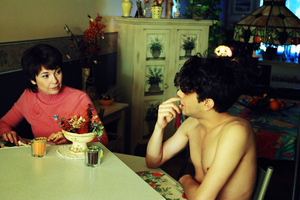
How did 20 year-old director, writer, and star of J'ai Tué Ma Mère (I Killed My Mother) Xavier Dolan do it? No really: How did someone so young accomplish something so sophisticated? That is the question I am dying to ask after seeing the screening of this incredible film at Frameline this year. When the French-Canadian Dolan premiered this film at Cannes, it made quite a splash -- and rightly so. The film tells the tumultuous story of the relationship between Hubert and his single mother, Chantale (played by the exquisite Anne Dorval). The film opens to a close-up shot of his mother eating a bagel with cream cheese in slow-motion -- a shot that eerily reminded me of my inability to eat breakfast with my father in the morning. His slurp-crunch cereal eating used to drive me batshit crazy as a teenager. What ensues is something of a study in how to inflict injury with words -- and it is just as gory as any slasher film.
The film is, at times, rather painful to watch. Hubert is a real teenage brat, and Dolan plays him beautifully. A real son-of-a-bitch ingrate. But he's damn handsome and there's something incredibly charming about him -- petulant, but charming. I was worried the film was going to wind up a celebration of bratty teenagedom at the expense of his struggling mother, but to my delight the film successfully balances Hubert's rants with sympathetic (if at times unflinching) portrayals of his mother. Neither of them are really very likable at the end -- their flaws and failures are so savagely exposed to the viewer that you can't help but cringe. That is the beauty of this film -- it's monstrous realness.
I do have a few quibbles -- mostly with the fact that every man in this movie looks a Greek statue who was just recently awoken from a 2000 year slumber. It's not that their bodies are ripped -- on the contrary, cinema outside the states has not idolized muscular men in the same way that American films have. Rather, these men's bodies often resemble more the kind you might find in 1970s gay porn: Hairy but not bearish, thin but not emaciated, toned but not muscular. But their faces are so beautiful that you can imagine feeling uncomfortable in their presence -- it's the kind of beauty that would never be caught dead associating with us peons. Hubert and the other young men who appear are not just physically stunning, but have simultaneously managed to put together an effortless fashion that is meant to look easy but is upon closer inspection incredibly meticulously sculpted. Dolan's curly locks fall over his face just so, suggesting both control and chaos.
This is the one point that makes me feel an outsider to Hubert's experiences. The life of the beautiful. I'm reminded of my very handsome best gay friend telling me when we were 19 that there was a secret look that very sexy guys would give each other to signal their interest in each-other -- and that I would never know that look. A secret society of sorts, replete with their own customs and predilections. Somehow I feel that Hubert's experiences are like that secretive look that I will never know. The problems of the beautiful.
But really this is the only bad thing I can say about this film. It's wonderful -- if at times grotesquely brutal. I hope Dolan continues to make films, although I'm told he has a fear of flying that kept him from attending Frameline. Get over it Dolan -- you need to make more movies, and this is a business that requires traveling.
Here's a trailer:
Frameline 34: "Elvis & Madona"By on June 21, 2010 11:12 AM | No Comments
"ELVIS & MADONA"
Director: Marcelo Laffitte
Trevor's Rating: 4 / 5 Stars
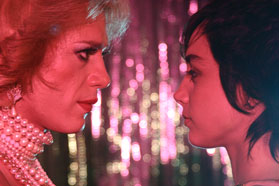
This was a charming little film. Elvis (played by the very sexy Simone Spoladore) is a soft-butch pizza delivery "girl" whose first assignment is to bring a huge heart of palm pizza to Madona (played by Igor Cotrim). Madona has just been the unfortunate victim of an assault and burglary by her dangerous lover, "Tripod Joe" (played by the truly villainous looking Sérgio Bezerra), who stole all of Madona's life savings after holding her up at gunpoint. Elvis of course swoops in to save the day.
Rare is the occasion for a transwoman character and a lesbian character to be seen romantically involved on screen. And for that, this movie brings us a new kind of story that is exciting and refreshing. The actor playing Madona is sadly not a transsexual -- as director Marcelo Laffitte reveals in an interview about the film's premier at Tribeca. But Cotrim does a great job bringing the quirky, eccentric Madona to life -- and does an especially good job when Madona goes in drag as a man to meet Elvis' parents. A male actor playing a transwoman playing a straight man. Incredible.
This film is something like a romantic comedy with a dash of drama thrown in, and should be regarded as such. It doesn't take itself too seriously, which is the film's best asset. The characters don't ponderously struggle with identity politics or over how they're going to have sex -- they just do it. This is what a lot of people -- trans, queer, and gay alike -- want out of LGBT cinema. Sure, we want to think critically about our lives and our politics, but sometimes we just want to munch on popcorn and see films that relate to our lives but that don't require too much thinking.
As I said, very charming. If the film makes a stop in your city, be sure to see it. No news on distribution yet, I think. Let's keep our fingers crossed!
Here's a few clips for your enjoyment:
The Times UK: "HIV and the rise of complacency"By on June 17, 2010 11:41 AM | 1 Comment
So first the French gay rags TETU and PREF, and now the very respectable The Times! My mission to take over Europe is in full swing! I was of course honored to be interviewed for this piece on HIV across the pond. The author is interested in the idea of gay generational gaps in approaching / experiencing HIV, and I tried to add a bit of complexity to the standard-issue story. Indeed, rather than make young gay men the target of our ire, I try to turn it around to say that fear-based HIV prevention and abstinence-only education are part of the story here. Check it out!
2010 Frameline Film Festival Picks!By on June 10, 2010 8:44 AM | No Comments
This year will be my fifth Frameline Film Festival! I just can't believe it. In the previous years, I've seen dozens of amazing queer films that change my life on a regular basis. Seriously, many of them are incredible! Each year I try to best my previous year's record of number of screenings attended, and this year is no different -- I've schedule 17 screenings at Frameline34. Seriously! I'm that addicted. I send around my schedule of films to friends each year, poking them until they buy tickets and join me. I decided this year to post my selections here on this blog to encourage you to come out and see some great gay cinema. Hope to see you there! Check out my picks, after the jump!
By on June 4, 2010 7:43 AM | No Comments
This new song by Robyn has totally been my jam ever since my bff played it for me last week. It has everything I need in a "fag beat": a female vocalist with a broken heart, a trance-y track mixed by a good DJ (Chew Fu), and a voice synthesizer.
Chris Bartlett gets EDBy on June 4, 2010 7:32 AM | No Comments
Except in this case, "ED" actually stands for "Executive Director," the new position my friend and fellow radical faerie Chris Bartlett has taken on at the William Way LGBT Community Center in Philly. Chris has been a gay rights activist in the area for over 20 years, and he is surely the perfect homo businesslady for the job. Here's a clip from the announcement in the Philadelphia Gay News:
"One of my commitments across my career has been looking at how to have the LGBT community in Philadelphia have a powerful participation by people of color, transgender people, elders, youth, etc.," he said. "We're at the point now where William Way is a stable organization and in a place where we're able to look at what communities can be better heard. We heard from the People of Color Coalition that they want us to put more energy into it and that's exactly the same place that I come from."
Congratulations, honey!!!
Terrorism Charges Dropped Against HIV-Positive Michigan ManBy on June 3, 2010 8:13 PM | No Comments
This is worth applause today -- and is undoubtedly the result of pressure from advocates (including the ACLU but also a myriad of HIV-positive advocacy organizations):
In a written opinion dismissing a charge of bio-terrorism against a 45-year-old HIV-positive man, Macomb County Circuit Court Judge Peter Maceroni ruled that the mere fact a person is HIV-positive is not enough to accuse him or her of unlawfully possessing a harmful biological substance.The eight page ruling, released Thursday morning, concludes that HIV is not transmitted by saliva without there being blood present. Prosecutors and preliminary hearing testimony did not indicate Daniel Allen was bleeding at the time he allegedly bit the victim, Winfred Fernandis, Jr.
Hallelujah!
And the new Scissor Sisters Video too!By on June 2, 2010 12:49 PM | No Comments
How did I miss this?
Lovely! Now I'm off to San Diego for the Social Science Research Council's Dissertation Proposal Development Fellowshop workshop. Phew! That was a mouthful!
xoxo
Kylie's "All the Lovers" Vid!By on June 2, 2010 12:45 PM | No Comments
Kind of like an underwear commercial, but better! I think the track is par for the course. Not great, not bad. Just okay.